
Digital SAT Exam Syllabus 2026
By John Trainer · · 2 min read
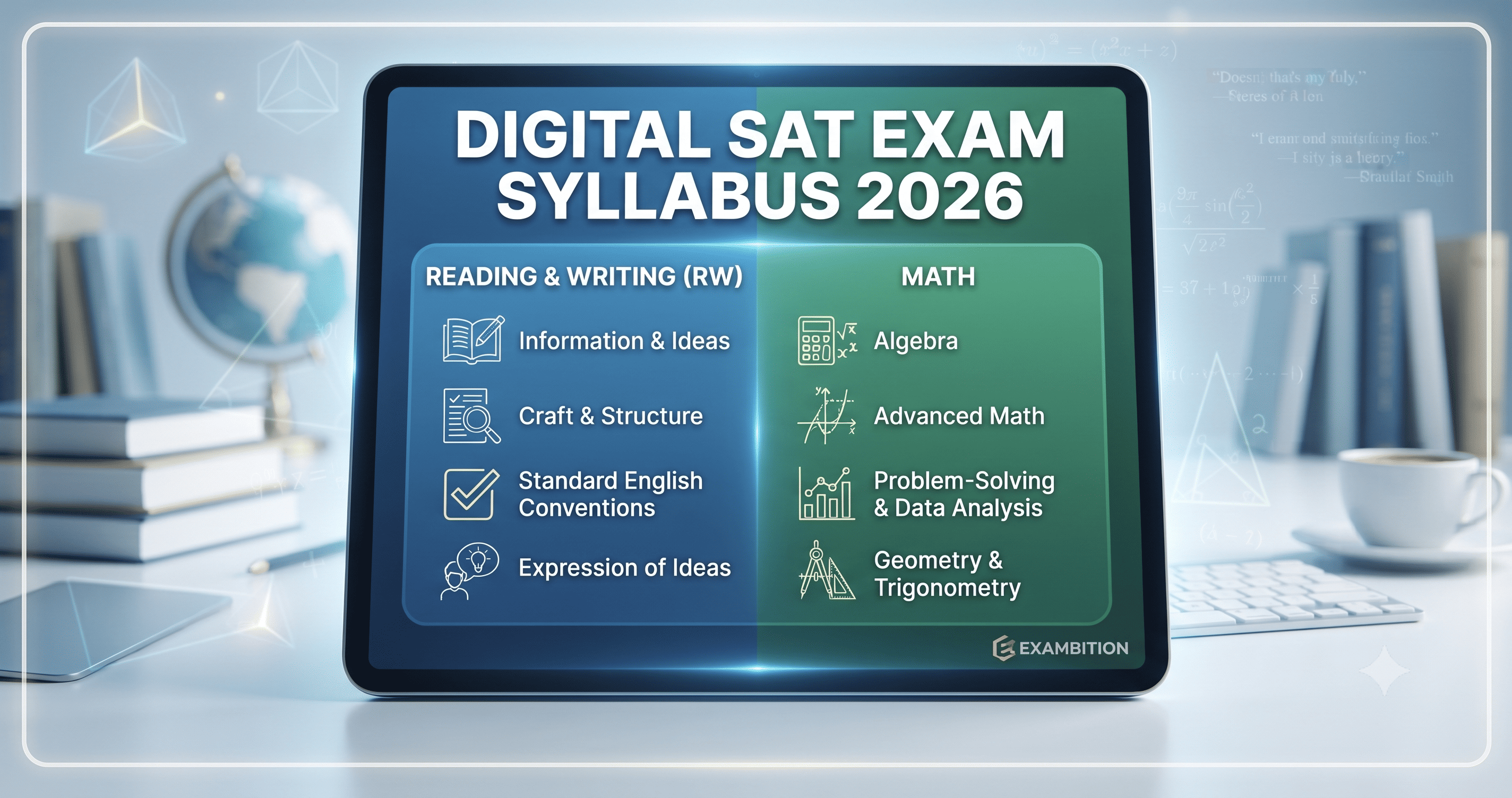
Preparing for the Scholastic Assessment Test (SAT) can feel overwhelming if you do not know where to focus your energy. With the exam fully transitioned to a digital, section-adaptive format, understanding the exact syllabus is your first step toward a top score of 1600.
The Digital SAT Exam Structure at a Glance
The digital SAT is streamlined into two core sections divided into two separately timed modules each:
- Reading and Writing (RW): 54 questions total, split into two 32-minute modules (64 minutes total).
- Math: 44 questions total, split into two 35-minute modules (70 minutes total).
- Total Time: 2 hours and 14 minutes (plus a 10-minute break between sections).
The test adapts dynamically: your performance in the first module of a section determines whether you receive an easier or harder second module.
Section 1: Reading and Writing Syllabus
Gone are the days of long, boring passages and isolated vocabulary word lists. The digital SAT features short, punchy passages (25 to 150 words), each paired with a single multiple-choice question. The section evaluates four main content domains:
- Information and Ideas (~26% / ~14 questions): Focuses on reading comprehension, central ideas, direct details, and drawing logical conclusions from text and informational graphics (like bar graphs and tables).
- Craft and Structure (~28% / ~15 questions): Tests your ability to understand high-utility words and phrases in context, analyze text structure, and evaluate cross-text connections.
- Standard English Conventions (~26% / ~14 questions): Evaluates grammar, sentence structure, punctuation (commas, semicolons, apostrophes), and agreement rules.
- Expression of Ideas (~20% / ~11 questions): Measures your editing skills to improve written expression, text flow, transitions, and rhetorical synthesis.
Section 2: Mathematics Syllabus
The math section allows a calculator for the entire duration—including a built-in Desmos graphing calculator directly inside the testing app. Roughly 75% of questions are multiple-choice, while 25% are student-produced responses (grid-ins).
- Algebra (~35% / 13–15 questions): Covers linear equations, linear functions, inequalities, and systems of linear equations in one or two variables.
- Advanced Math (~35% / 13–15 questions): Focuses on nonlinear expressions and equations, including quadratic equations, polynomial functions, exponential functions, and radical expressions.
- Problem-Solving and Data Analysis (~15% / 5–7 questions): Tests ratios, rates, proportional relationships, percentages, descriptive statistics (mean, median, spread), probability, and data interpretation from scatterplots.
- Geometry and Trigonometry (~15% / 5–7 questions): Covers area and volume formulas, lines, angles, triangles, right-triangle trigonometry, and circle theorems.